A magical, mystery tour of childhood stories
Young boy on a roof.
Shutterstock/Legion MediaOld Father Frost
Vladimir Odoevsky (translated by James Riordan)
Old Father Frost is a kindly bearded man who lives in a winter wonderland. Does that ring a bell? Ded Moroz or Father Frost is the Slavic equivalent of Father Christmas. In 1840 Prince Vladimir Odoevsky first wrote the centuries-old fairy tale about the mythical figure who lived in an ice kingdom accessible only through a magical well. Generations of Soviet, and now Russian, children have listened with rapt attention to the story of how hard work is rewarded with the gift of a necklace made from icicles. The story almost did not survive, and was originally banned in the Soviet Union for being too bourgeois. It was restored to its rightful place in Russian folklore on instructions from Stalin.
Grishka and the Astronaut
Anatoly Mityayev (translated by Ronald Vroon)
The year is 1970. The Brezhnev era has settled over the USSR, and with it come inspirational stories about young Soviet children who can literally reach for the stars. In this particular story an astronaut advises a boy to visit the moon, sparking a wild ride into space for him. Put in its historical context this story reflects a time when the Soviet Union had not yet fallen into stagnation and astronauts were heralded as symbols of the mighty superpower’s promise. But all that aside – what kid doesn’t love space? This story is worth exploring just for the futuristic ’70s Soviet art accompanying it.
Grandpa Mazai and the Hares
Nikolai Nekrasov (translated by Irina Zheleznova)
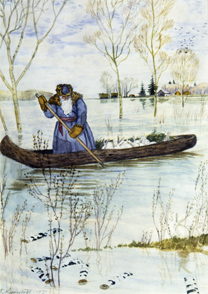 |
| Grandfather Mazay and the Hares. Source: Sverdlov/RIA Novosti |
We are back in 1970. The Brezhnev era has settled over the USSR, and with it come inspirational stories about young Soviet children who can literally reach for the stars. In this story, an astronaut advises a boy to go to the moon, and sets off a wild ride into space for him. Placed in its historical context, this story reflects a time when the Soviet Union had not yet fallen into stagnation and astronauts were heralded as symbols of the mighty superpower’s promise. But leaving that aside, which child doesn’t love space? This story is made more fascinating by the futuristic ’70s Soviet art accompanying it.
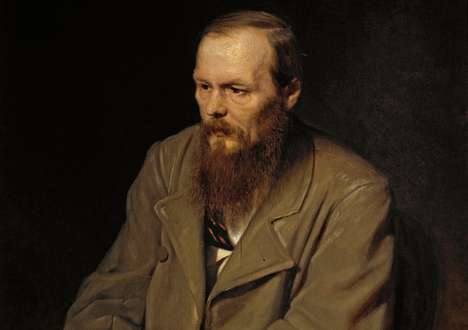
Grandpa Mazai is a robed grandfather, who wields a stick, but without magical powers. Although he may not have an ice kingdom to which he can transport kids, he does have an abundance of human empathy, which leads him to rescue hares from a flooded river. Written in the 19th century, this poem has not dated, and is a must-read to understand how Russians relate to the rural space. Nekrasov’s sympathetic portrayal of peasant life won him plaudits from no less a figure than (Fyodor) Dostoevsky.
Rainbow Flower
Valentin Kataev (translated by Fainna Glagoleva)
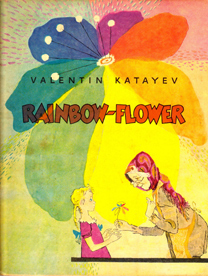 |
| Rainbow flower. Source: Progress Publishers |
A true staple of the Soviet Union, this is a heart-warming tale about a girl who is given a beautiful flower with seven petals.
Each petal is a different color of the rainbow, and every time she plucks one off she is granted a wish.
She uses her first six to wish for all the classic treats that a child could want, but she realizes that these haven’t made her happy, and uses her final wish to cure a boy’s bad leg. Read this one to your children to show them that material goods are secondary to friendship and caring for others.
In the Van
Samuil Marshak(translated by Margaret Wettlin)
No Soviet childhood would be complete without the influence of Samuil Marshak, the man Maxim Gorky described as “the founder of our children’s literature.” A translator and philosophical poet in his own right, Marshak was at the forefront of creating a new style of Soviet literature for children, inspired by British writers such as A.A. Milne and Lewis Carroll. He almost fell prey to the political Sword of Damocles twice: during the Great Purge of 1937, and in the final years of the anti-Jewish “battle against cosmopolitanism” in the 1950s. Put aside the politics and enjoy this playful story about a woman who loses her dog on a journey. The end is a surprise but, to find out, you’ll have to read the poem.
All rights reserved by Rossiyskaya Gazeta.
Subscribe
to our newsletter!
Get the week's best stories straight to your inbox